
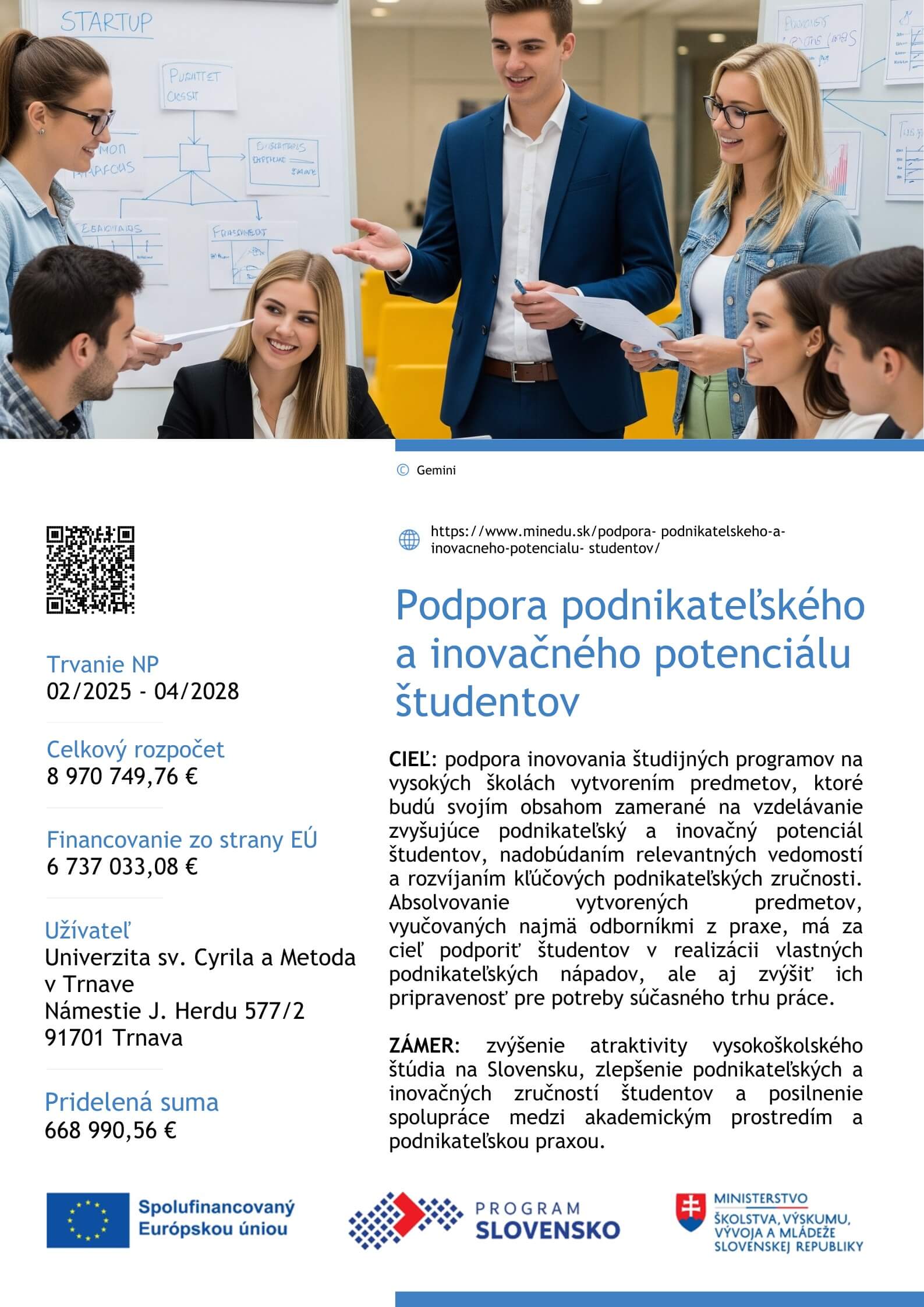
The UCM Institute of Management is participating in a national project to develop students' entrepreneurial and innovative potential. The initiative aims to strengthen entrepreneurial skills, creative thinking, and the ability to put innovative ideas into practice by modernising study programmes and fostering closer cooperation with experts from the business community.
Project activities funded by EU financial support from the Slovakia Program focus on innovating the Tourism and Hospitality Management study programme, offered as a full-time programme (184070) at the first level of higher education (Bachelor’s degree). The innovation includes new third-year courses titled “Business Marketing and Brand Building in Tourism” and “Venture Ecosystem,” which are part of the programme’s core curriculum and included in the List of Selected Study Programmes for Smart Specialisation SK RIS 3 2021+.
The purpose of the project activities is to improve the quality, relevance, and practical focus of education by developing and implementing new course content that reflects current trends in business, start-ups, marketing communications, and brand building within the tourism and hospitality sector. The emphasis is on the systematic development of competencies in brand building, including defining brand identity, creating a value proposition, and positioning the brand in the market within the tourism and hospitality context. Significant attention is devoted to digital marketing, including social media management, search engine optimisation, content marketing, email marketing, and the use of CRM tools, as well as to the development of sales techniques and customer journey management.
The rationale for implementing the proposed activities lies in the dynamic evolution of the tourism market, growing competition among businesses and destinations, and the increasing demands of the professional world for graduates in marketing, brand building, digital communication, and data analysis. The current course content requires targeted updates to align with the needs of the labour market, the digitalisation of business, and the principles of smart specialisation, including the ability to respond to customer feedback and to apply agile approaches to the creation and innovation of products and services in tourism.
Project activities will focus on innovating course content, teaching methods, and practical course outcomes, with the content fully aligned with the thematic framework of the study modules published by the Ministry of Education, Science, Research and Youth of the Slovak Republic. This innovation will support the integration of theoretical knowledge with practical case studies, project-based learning, and the resolution of real-world business situations in the areas of brand building, digital marketing, sales, and customer feedback. Emphasis will also be placed on applying the principles of agile development and working with the concept of the Minimum Viable Product.
The expected outcomes of the project are:
